

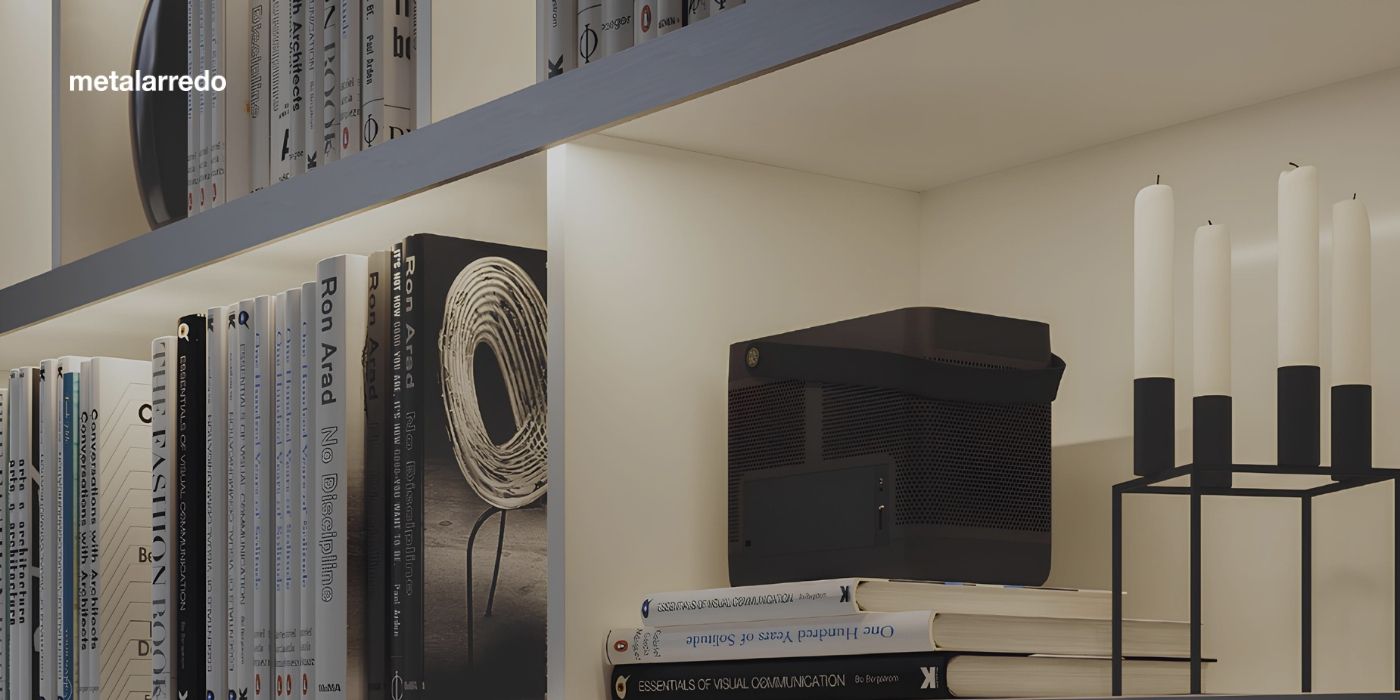
Illuminating bookcases and wall units: when light becomes part of the design
Bookcases and wall units are often the place where personal objects, books, materials, and decorative details coexist. They are elements used daily, observed both up close and from a distance, capable of reflecting the style and habits of the people who live in the space.
Integrated LED lighting doesn’t just serve an aesthetic purpose: it makes these elements more readable, organized, and functional, enhancing the way they are actually used.
Designing the lighting for a bookcase or wall unit means considering light as a structural part of the project, on par with materials, proportions, and finishes.
In this blogpost, we explore how to effectively illuminate bookcases and wall units, analyzing the functions of light, the most effective integration solutions, and the opportunities offered by LED systems designed for furniture, with a focus on visual comfort, aesthetic impact, and design flexibility.
Table of contents:
- Lighting for bookcases: balancing function and style
- Where to position the light: effective design solutions
- Functional lighting, carefully controlled
- One element, multiple scenarios
- Integrated lighting and custom furniture: a unified project
Lighting for bookcases: balancing function and style
Integrating lighting into a bookcase addresses very practical needs that go beyond mere decorative effects.
On the functional side, lighting makes it easier to read titles, improves spatial perception, and increases accessibility to shelves and compartments, especially in rooms with soft general lighting or during evening hours. A well-lit bookcase is clearer, more organized, and easier to use.
On the decorative side, lighting plays a crucial role in:
- adding depth to complex structures,
- highlighting materials such as wood, glass, or lacquered surfaces,
- creating a visual rhythm across the wall unit.
When both aspects are carefully balanced, the bookcase is no longer just a storage element—it becomes an architectural feature that interacts with the environment through subtle, controlled light, fully aligned with the overall design.
Where to position the light: effective design solutions
Light placement is one of the most critical aspects when designing bookcases and wall units. The goal is not to “see the light” but to perceive its effect, avoiding solutions that are intrusive or poorly integrated.
The most effective applications typically use LED profiles with integrated strips, designed to blend seamlessly into the furniture while ensuring uniform light distribution.
Some practical examples include:
- LED profiles in vertical uprights, ideal for following the height of the bookcase and creating continuous illumination that enhances the structure without casting unwanted shadows.
- Profiles with indirect lighting positioned on shelf edges, directing light downward—a solution often used to illuminate shelf contents without glare.
- Profiles integrated at the front of glass shelves, allowing light to pass through the material and create a distinctive visual effect.
- Perimeter lighting at the back of the unit, designed to visually separate the bookcase from the wall and add depth.
- Lighting integrated at the top, providing softer illumination that contributes to the overall atmosphere of the living space.
The choice of profile, optics, and positioning should always consider the intended use of the bookcase and the type of environment in which it is placed.
Functional lighting, carefully controlled
A well-designed lighting system for bookcases must be balanced and adaptable. Beyond the quality of the light itself, it’s essential to plan the control system, so lighting can adjust to different moments of the day.
Metalarredo solutions allow dedicated activations integrated into LED profiles, creating a complete system that includes:
- proper power supply according to length and installed load;
- dimming options to adjust light intensity;
- independent control separate from the room’s general lighting.
This setup allows the bookcase to be lit only when needed or to serve as ambient lighting in the evening, without compromising visual comfort. The result is an efficient, flexible LED lighting system fully integrated with the furniture.
One element, multiple scenarios
A well-lit bookcase can serve multiple roles within the same space, depending on the intensity and type of light used.
It can become:
- a reading or task light for consulting books or documents;
- an accent light that highlights objects, books, and decorative details;
- ambient lighting that defines the atmosphere of the living space without relying on general overhead lighting.
In this way, the bookcase is no longer a static element but becomes an active component of the room’s lighting design.
Integrated lighting and custom furniture: a unified project
In contemporary, especially custom furniture projects, lighting should be considered from the earliest design stages.
Metalarredo solutions are designed to integrate seamlessly into furniture systems, offering maximum customization in terms of:
- lengths and configurations,
- power and light output,
- finishes and installation types.
This approach helps designers, architects, and furniture manufacturers create bookcases and wall units where light and structure speak the same design language.
If you are planning a custom solution or want to integrate LED lighting into your furniture systems, the Metalarredo team is at your disposal. Fill out the contact form below or email us at
Want to find out more? Fill out the form below, and a Metalarredo lighting expert will take up your request as soon as possible.

Select your language
Sign up for the newsletter and stay up-to-date
© 2024 Copyright. Metalarredo S.r.l. | Privacy policy. Cookie Policy | P.IVA e C.F. 04485950267 | Iscrizione REA TV-354017 | Cap. sociale 100.000€
Designed by Vaultinn